


Gemstone transparency guide: Understanding light and clarity


When you start exploring the fascinating world of fine jewelry, the way a beautiful mineral interacts with light is often its most mesmerizing feature. This optical property, known formally as gemstone transparency, plays a monumental role in determining a stone's ultimate beauty, cut, market rarity, and financial value. Whether you are looking for a sparkling crystal clear center stone for a custom ring or a deep, mysterious mineral for a statement piece, understanding how light travels through a crystal is essential.
At Lot of Jewelry, we believe that an educated collector is an empowered buyer. By understanding how light behaves within different crystal structures, you can confidently evaluate jewelry options and pick the perfect style for your collection. In this comprehensive resource, we break down the scientific and aesthetic details of optical clarity, providing an easy-to-use gemstone transparency chart along with expert identification strategies to help you find your ideal gem.
What is gemstone transparency and why does it matter?
At its core, the degree of optical clarity describes how easily light passes through a mineral and how much it scatters as it journeys through the crystal lattice. When light hits the surface of a mineral, it can be reflected off the top, absorbed by trace elemental impurities, or transmitted straight through the material. The structural arrangement of atoms inside the crystal dictates which of these paths the light will take.At Lot of Jewelry, our master jewelers carefully evaluate these exact optical characteristics to ensure every piece of jewelry is cut to perfectly highlight its organic structural strengths.
The official categories of gemstone transparency
To categorize how much light can travel through a mineral, gemologists utilize a standardized scale that spans from completely crystal clear to entirely dark. Understanding these distinct levels will help you quickly identify different mineral families and determine how a particular ring or necklace will look under varying light sources.
The following index outlines the five primary classifications used by gemological laboratories worldwide to evaluate light transmission:
Transparency Class | Technical Definition | Visual Effect on Objects Behind the Stone | Common Material Examples |
|---|---|---|---|
Transparent | Light passes through completely uninterrupted with virtually zero scattering. | Outlines are perfectly crisp, sharp, and entirely legible. | Diamond, sapphire, ruby, emerald, amethyst |
Semi-Transparent | Light passes through easily, but slight internal inclusions cause mild scattering. | Outlines behind the stone appear slightly blurry or soft. | High-grade jadeite, chalcedony, moonstone |
Translucent | Light passes through the material, but you cannot see through it clearly. | Only vague shadows or light sources are visible through the gem. | Opal, carnelian, rose quartz, chrysoprase |
Semi-Translucent | Only a tiny fraction of light can pass through the thinnest edges of the stone. | No shapes or objects can be discerned through the main body. | Turquoise, jade, agates, certain labradorite specimens |
Opaque | Absolutely no light passes through the body of the material at all. | Objects behind the stone are completely hidden from view. | Onyx, jasper, malachite, lapis lazuli, pyrite |
When shopping for jewelry, keeping a digital gemstone transparency chart on hand allows you to instantly verify the optical category of any piece you are considering. Knowing these classes makes it much easier to discuss structural properties with your jeweler.
What is gemstone transparency and why does it matter?
For classic luxury jewelry designs like engagement rings and tennis bracelets, transparent gemstones remain the absolute gold standard. These stones possess a highly ordered internal crystal lattice that allows light to pass through completely unobstructed, creating unparalleled brilliance, fire, and scintillation when properly faceted.
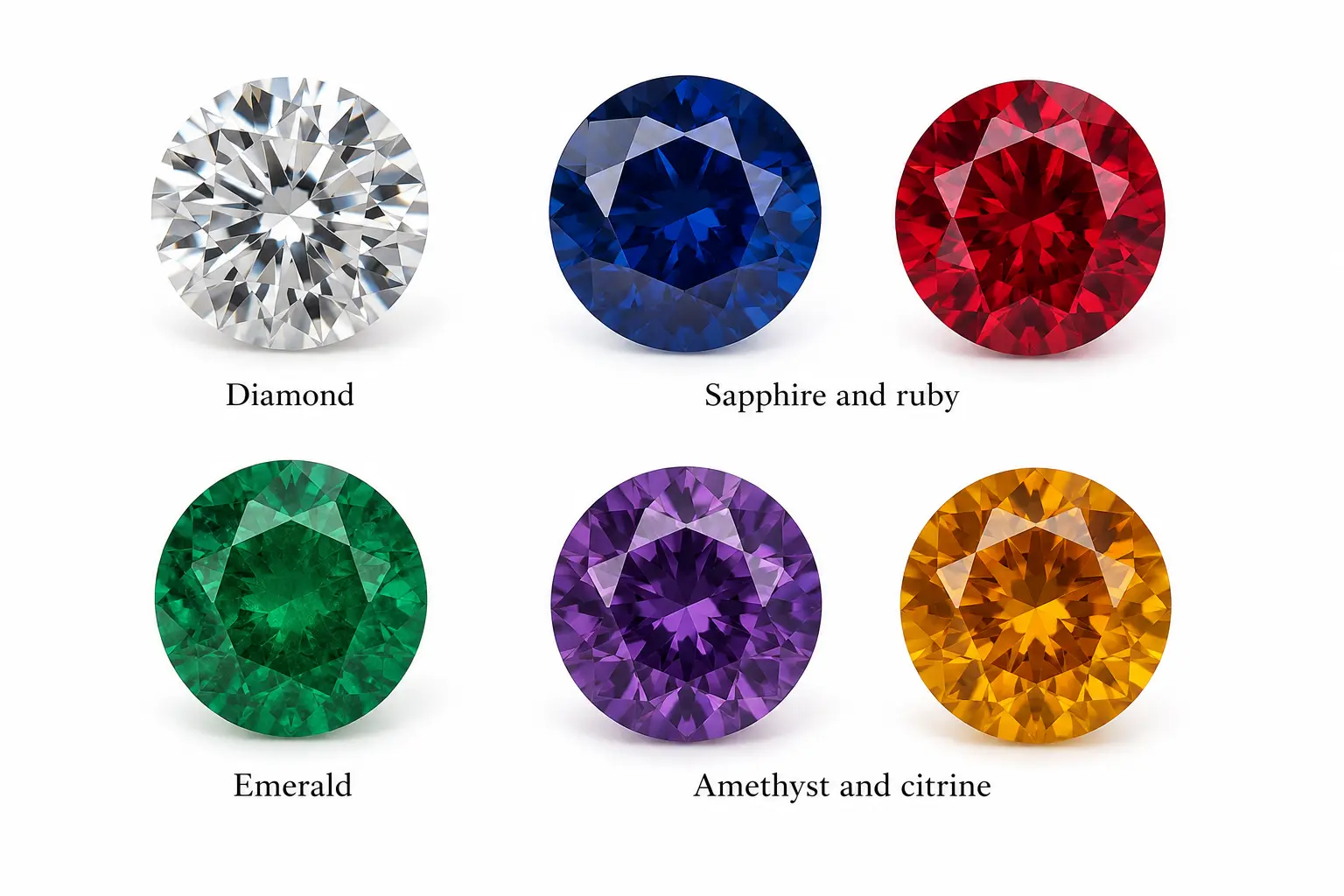
When evaluating a high-end clear mineral, knowing a specific transparent gemstone name can help you search for the exact physical properties you desire. The most famous and highly sought-after options in this premium category include:
- Diamond: The ultimate clear mineral, renowned for its incredible hardness and exceptional ability to split white light into brilliant rainbow flashes.
- Sapphire and ruby: Part of the corundum family, these minerals offer stunning rich colors while maintaining magnificent, deep crystal clarity.
- Emerald: A beautiful member of the beryl family that is highly prized for its rich green hues, though it frequently features tiny, organic internal inclusions.
- Amethyst and citrine: Popular quartz varieties that combine accessible pricing with spectacular, high-grade optical transparency.
If you are looking for a unique alternative for a custom project, searching for a lesser-known transparent stone name like morganite, tanzanite, or tsavorite garnet can open up a world of breathtaking design possibilities. At Lot of Jewelry, we specialize in sourcing these rare clear varieties to create timeless, distinctive heirlooms.
Navigating our ultimate translucent gemstones list
While clear stones captivate us with their brilliant sparkle, semi-clear minerals offer a completely different type of visual charm. These stones do not allow you to see through them clearly, but they hold light within their structures, creating a soft, ethereal inner glow that feels uniquely organic.
To help you explore these mesmerizing choices, our curated translucent gemstones list highlights the most stunning varieties used in modern jewelry design:
- Moonstone: Famous for its adularescence, an optical phenomenon that looks like billowing, bluish-white light floating just beneath the surface of the stone.
- Opal: A magnificent mineraloid that diffracts light internally, producing shifting patterns of brilliant neon colors known as play-of-color.
- Chalcedony: A smooth form of quartz that features a beautifully distinct, milky appearance that catches ambient light perfectly.
- Rose quartz: A romantic, pastel-pink mineral that often possesses a dreamy, cloud-like semi-clear texture.

Choosing a piece from our translucent gemstones list is an incredible way to add a soft, sophisticated touch of color to your wardrobe. These gems look especially stunning when set in warm yellow gold or clean white gold, which enhances their signature internal glow.
The difference between transparent vs opaque stones
The main structural difference between clear options and completely dark options comes down to their internal composition. Opaque stones are typically made of dense aggregates of tiny, interlocking mineral crystals or contain heavy trace elements that absorb light entirely rather than letting it pass through.
To give you a clear visual comparison of how these distinct mineral styles look and feel, let us look at the following breakdown:
- Visual character: Clear options reflect a lively, energetic dance of light, while dark stones showcase deep, grounding colors and fascinating geometric surface patterns.
- Finishing styles: Clear options are almost always cut with precise facets to enhance their sparkle, whereas opaque options are shaped into smooth, highly polished cabochons or beads.
- Durability and care: Many classic dark stones like malachite or turquoise are slightly softer and more porous than hard, clear gems like sapphire, meaning they require gentle, mindful care over time.
Whether you prefer the radiant brilliance of a classic transparent gemstone name or the bold, earthy statement of an opaque stone, Lot of Jewelry offers a curated selection of both styles to suit your personal aesthetic.
How cutting and faceting enhance gemstone transparency
The natural state of a rough mineral is rarely as dazzling as the polished piece you see sitting in a boutique showcase. A stone's final beauty relies heavily on the skill of the lapidary, who must analyze the raw crystal's gemstone transparency before making a single cut.
If a rough mineral has excellent internal clarity, the lapidary will craft precise geometric facets on its surface. These flat faces act like a sophisticated system of mirrors, reflecting light around the inside of the stone before sending it back out to the viewer's eye. If the angles are off by even a fraction of a degree, light will leak out of the bottom of the stone, causing it to look dull and lifeless. At Lot of Jewelry, our artisans use advanced, state-of-the-art tools to ensure every facet is aligned perfectly with the stone's natural crystal structure.
Final thoughts on selecting the perfect jewelry piece with Lot of Jewelry
Investing in fine jewelry is a highly personal experience that blends your individual style with a deep appreciation for the wonders of geology. By understanding how transparent gemstones contrast with semi-clear and dark varieties, you can navigate the jewelry market with complete ease and clarity.
When you choose to design your next custom piece with Lot of Jewelry, you work side-by-side with passionate jewelry experts who care deeply about sourcing high-quality, ethically mined minerals. Whether you want to explore an expansive gemstone transparency chart or find a rare, distinctive transparent gemstone name for a custom design, we are here to bring your creative vision to life. Reach out to our design team today to schedule your personalized consultation.Perfect for collectors and jewelry enthusiasts alike, this guide from Lot of Jewelry helps you identify any transparent gemstone name or transculent stone name with total confidence.
FAQ
What is the transparency of a gemstone?
The clarity of a mineral refers to its capacity to let light travel through its body. Gemologists evaluate this property by observing how much light passes through uninterrupted versus how much light is scattered or absorbed by internal inclusions. This characteristic is broken down into five primary categories: transparent, semi-transparent, translucent, semi-translucent, and opaque.
What kind of stone is transparent?
A clear stone is any mineral that allows light to pass through its body with virtually zero scattering, allowing you to see objects clearly through the crystal. Classic examples include diamonds, sapphires, rubies, and clear quartz. These minerals are highly prized for their capability to be faceted into brilliant, sparkling shapes that reflect light beautifully.
What does it mean when a gemstone is translucent?
When a mineral is described as semi-clear, it means that light can pass through its body, but it is scattered significantly by the internal crystal structure or inclusions. As a result, you cannot see clear images or text through the stone. Instead, these stones display a beautiful, soft, milky internal glow that looks exceptionally elegant in jewelry designs.
What are transparent stones called?
In the jewelry industry, clear stones are often referred to as crystalline, diaphanous, or simply transparent gems. Depending on their specific chemical makeup, a clear piece might be called a diamond, white sapphire, topaz, or rock crystal quartz. They are highly sought after for their exceptional fire and brilliance.
What are 5 examples of transparency?
When looking at high-quality mineral examples used in luxury jewelry, five classic clear stones include diamond, blue sapphire, red ruby, green emerald, and purple amethyst. Each of these iconic gems allows light to flow effortlessly through its crystal lattice, creating an exquisite display of color and sparkle.